

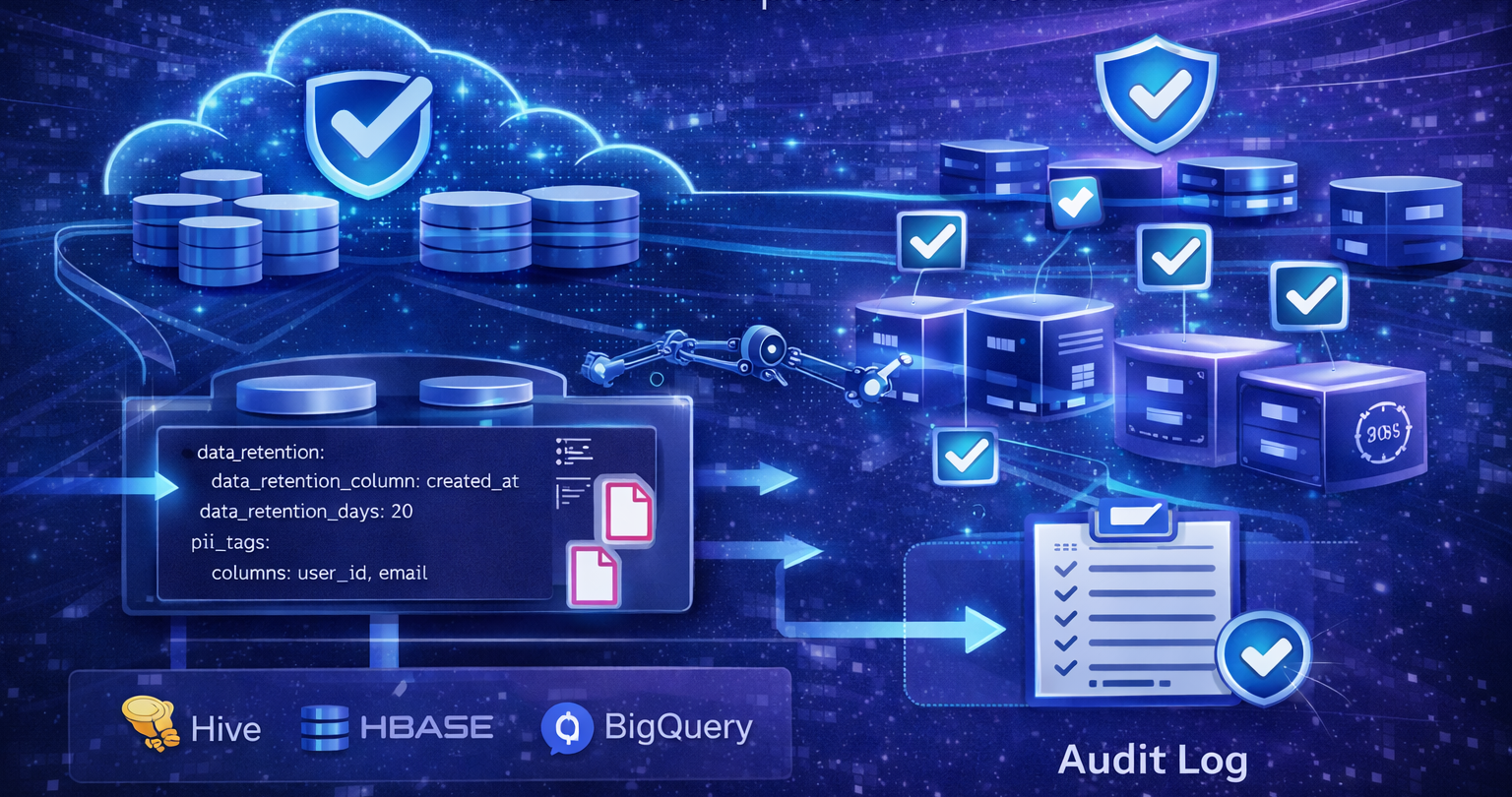
Enabling GDPR-Compliant, Automated Data Lifecycle Management
Introduction
In today’s data-driven world, organizations are not only responsible for collecting and processing data—they are also accountable for how long they retain it and when they delete it.
Regulations such as GDPR require strict control over data retention, especially for personally identifiable information (PII). Yet, most organizations rely on manual processes, ad hoc scripts, or incomplete policies to manage data lifecycle.
At Datilis, we address this challenge with a Data Retention Framework—a scalable, automated solution that ensures data is retained, managed, and deleted in full compliance with regulatory and business requirements.
The Problem: Data Retention is Complex and Risky
Organizations typically struggle with:
- Lack of centralized retention policies
- Inconsistent handling of PII across systems
- Manual deletion processes prone to errors
- Difficulty responding to customer deletion requests (GDPR “right to be forgotten”)
- No traceability of what data was deleted and why
This leads to:
- Regulatory risk and potential fines
- Data over-retention (increased storage and risk exposure)
- Operational inefficiencies
- Loss of customer trust
The Datilis Approach: Retention as a Framework
Our solution transforms retention from manual processes into a configurable, automated framework embedded in your data platform.
Core Principles
1. Metadata-Driven Retention Policies
Retention rules are defined directly within your data models (e.g., dbt):
- Retention column (e.g., timestamp field)
- Retention period (e.g., 14 days)
- PII classification and tagging
Example:
data_retention:
  data_retention_column: customer_id
  data_retention_days: 14
This ensures:
- Policies are transparent and version-controlled
- Retention is aligned with data definitions
- No hidden logic in scripts
2. Automated Retention Job Generation
Using metadata and tags, the framework automatically:
- Identifies tables requiring retention enforcement
- Generates the necessary data pileines
- Applies consistent deletion logic
This eliminates:
- Manual SQL scripting
- Inconsistent retention logic
- Human error
3. Scheduled Deletion Workflows
Retention jobs run automatically (e.g., nightly):
Example logic:
DELETE FROM customer_tbl
WHERE customer_ingest_ts < CURRENT_DATE - INTERVAL '14 days'
Business impact:
- Continuous compliance
- No manual intervention
- Predictable data lifecycle
Key Use Cases
🔹 Use Case 1: Time-Based Retention (Automated Cleanup)
Scenario:
Data must be deleted after a defined retention period.
How it works:
- PII data is labeled and tagged
- Retention rules defined in metadata
- Pipeline jobs execute deletion queries daily
Outcome:
- Fully automated lifecycle management
- Reduced storage and risk exposure
🔹 Use Case 2: Customer-Initiated Deletion (GDPR Compliance)
Scenario:
A customer requests deletion of their personal data.
How it works:
- Customer IDs are collected in a staging table
- Framework identifies all datasets containing PII
- Deletion jobs are generated dynamically
- SQL updates/delete operations are executed across all relevant tables
Example:
UPDATE customer_raw
SET customer_name = NULL
WHERE customer_id IN (...)
Outcome:
- Full compliance with “right to be forgotten”
- Consistent deletion across all systems
- Audit-ready processes
Architecture Overview
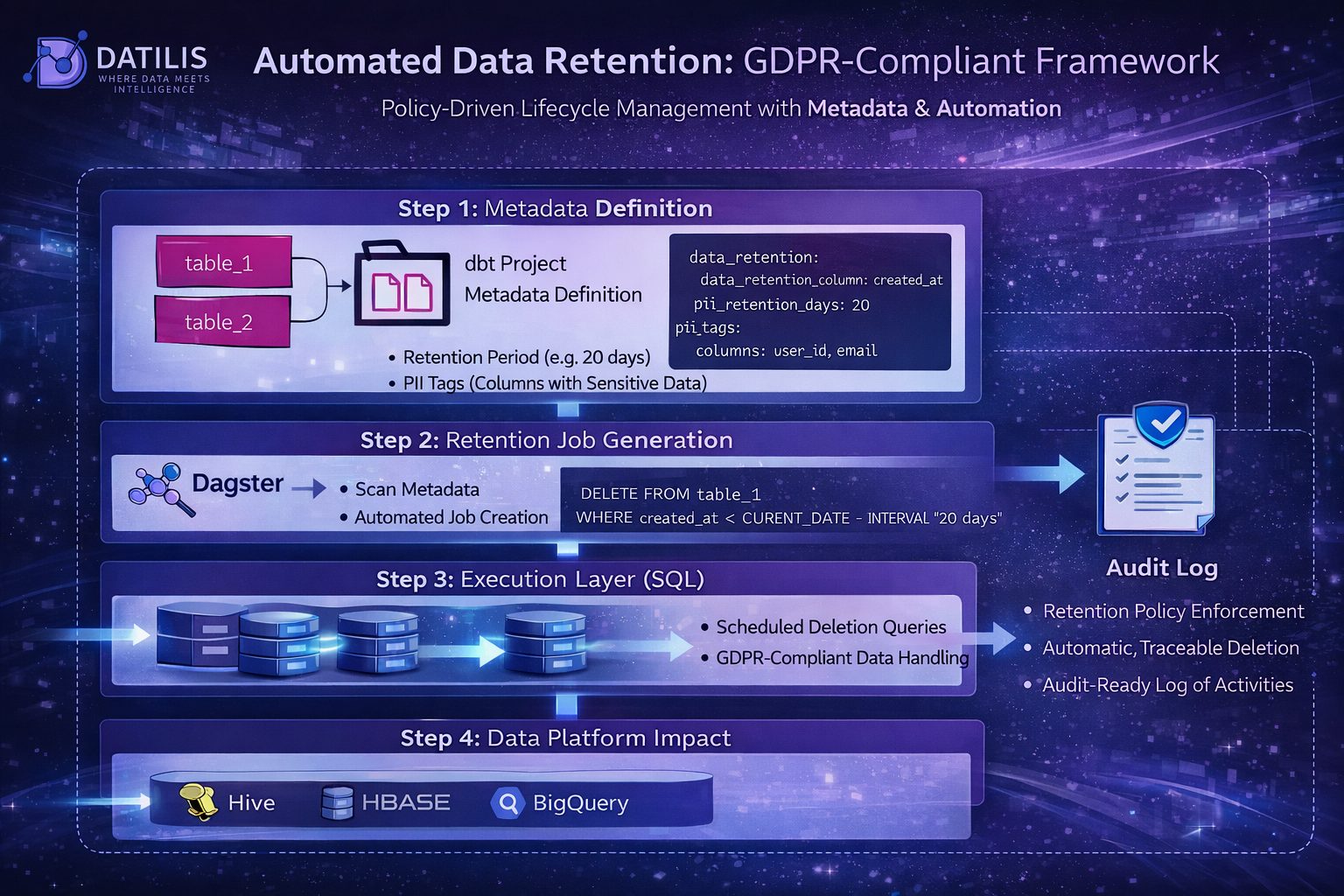
The Data Retention Framework integrates seamlessly into your data platform:
Step 1: Metadata Definition (dbt)
- Retention rules defined in models
- PII columns tagged
Step 2: Retention Job Generation
- Dagster scans metadata
- Generates deletion workflows
Step 3: Execution Layer
- SQL-based deletion or anonymization
- Runs on data platform (e.g., BigQuery, Hive)
Step 4: Data Platform Impact
- Data cleaned automatically
- Retention policies enforced consistently
Integration with Data Platform
The framework works directly on your data platform:
- BigQuery
- Hive / HBase
- Any SQL-compatible system
It ensures:
- No data duplication
- No external processing needed
- Native performance and scalability
Key Capabilities
Centralized Retention Governance
- Single place to define policies
- Aligned with data models
Automated Deletion Workflows
- No manual scripts
- Fully orchestrated
PII-Aware Processing
- Identify sensitive data automatically
- Apply correct retention rules
Auditability & Traceability
- Track what was deleted and when
- Support compliance audits
Flexible Retention Strategies
- Time-based deletion
- Event-based deletion (customer request)
- Anonymization support
Business Benefits
Organizations implementing this framework achieve:
- Full GDPR compliance readiness
- 80% reduction in manual retention effort
- Reduced risk of regulatory fines
- Lower storage costs through controlled retention
- Increased customer trust
Strategic Value
Data retention is not just compliance—it is:
- Risk management
- Cost optimization
- Trust enablement
By embedding retention into your data platform, you create:
A governed, compliant, and future-proof data ecosystem
Why Datilis
Datilis delivers:
- Deep expertise in data governance and platform engineering
- Framework-driven approach (not one-off solutions)
- Integration with modern tools (dbt, Dagster, Spark)
- Focus on compliance + scalability + automation
Conclusion
With increasing regulatory pressure and growing data volumes, organizations must rethink how they manage data lifecycle.
The Datilis Data Retention Framework ensures that:
- Data is kept only as long as needed
- Sensitive data is handled responsibly
- Compliance is automated and auditable
Next Steps
- Assess current retention policies
- Identify PII-heavy datasets
- Implement metadata-driven retention rules
Contact Datilis to implement your GDPR-compliant data retention framework