

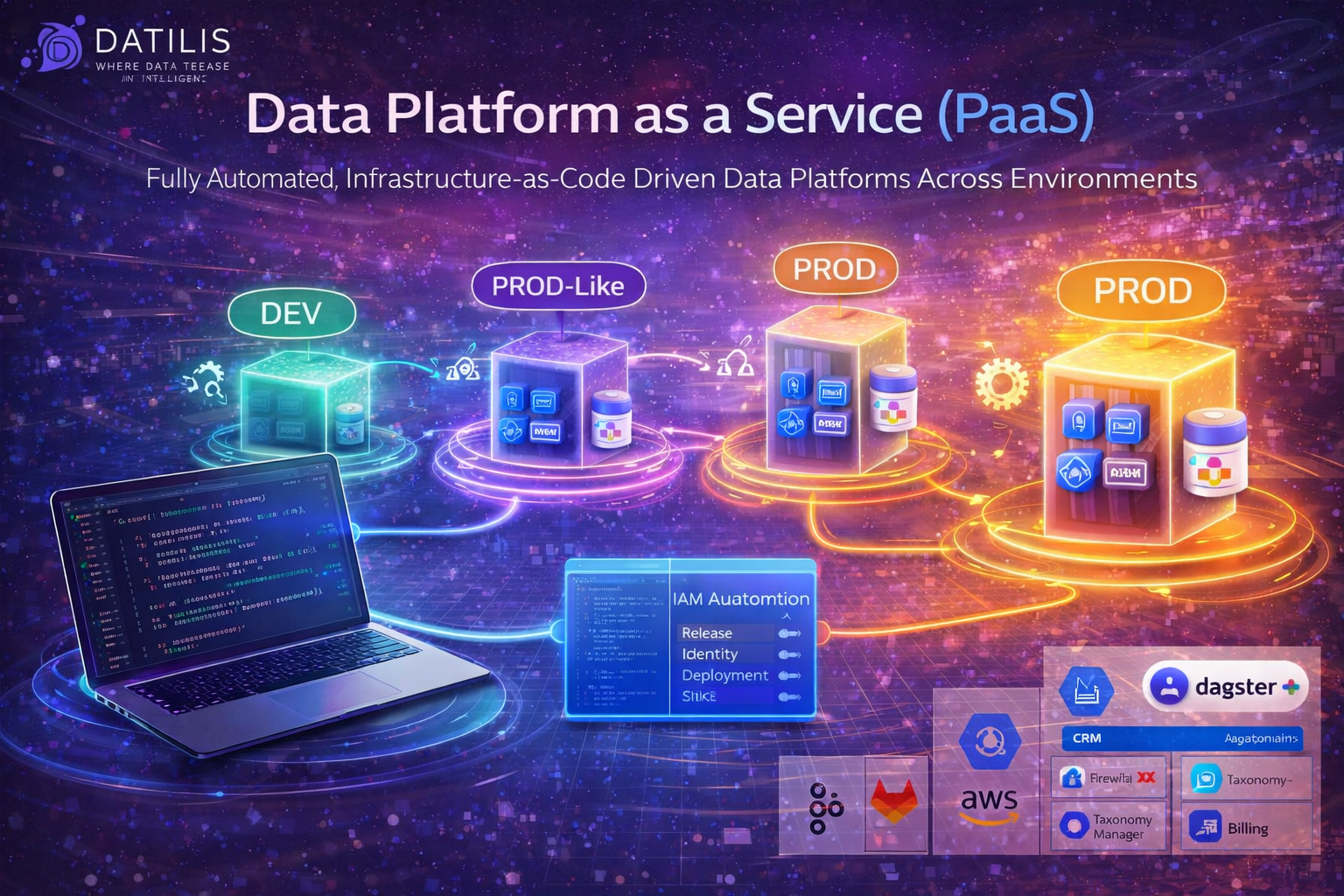
Fully Automated, Infrastructure-as-Code Driven Data Platforms Across Environments
Modern data platforms must be scalable, reproducible, secure, and fast to deploy. Yet many organizations still rely on manual infrastructure setup, inconsistent environments, and fragmented deployment processes.
At Datilis, we solve this with a Data Platform as a Service (PaaS) approach—where the entire platform is defined and deployed using Infrastructure as Code (IaC).
This enables organizations to build and operate consistent environments (DEV, PROD-like, PROD) with full automation, governance, and scalability.
The Problem: Manual and Inconsistent Platform Setup
Organizations typically struggle with:
- Manual infrastructure provisioning
- Environment inconsistencies (DEV ≠ PROD)
- Complex networking and security configurations
- Difficult onboarding of new domains or teams
- Lack of reproducibility and auditability
The result:
- Slower delivery
- Higher operational risk
- Increased costs
- Limited scalability
The Datilis Approach: Data Platform as a Service
We treat the data platform as a product, delivered via automation.
Our PaaS solution is built on:
- Infrastructure as Code (IaC)
- Automated environment provisioning
- Standardized platform components
- Integrated security and governance
Architecture Overview
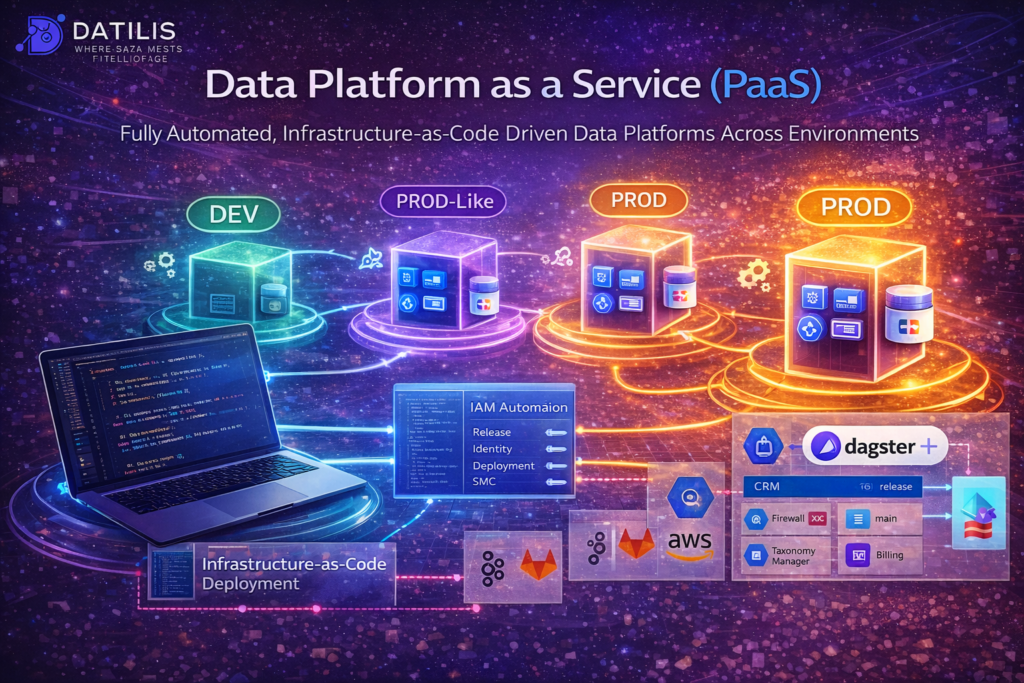
The platform spans multiple layers:
🔹 1. Infrastructure Layer
Defined entirely via IaC:
- Networking (VPCs, firewalls, VPNs)
- Kubernetes (k8s clusters)
- Storage (Cloud/S3 Storage, BigQuery)
- Security (KMS, Secret Manager)
Outcome:
- Fully reproducible infrastructure
- Consistent deployments across environments
🔹 2. Platform Core (Shared Services)
Central platform components include:
- Dagster/Airflow orchestration layer
- dbt transformation layer
- Artifact management (GitLab, CI/CD)
- Secret management
- Taxonomy and governance services
Outcome:
- Standardized platform capabilities
- Reusable across all domains
🔹 3. Data Domains Layer
Each domain operates independently:
- CRM
- B2B
- Domain-specific datasets
Each domain includes:
- BigQuery datasets
- Storage buckets
- Isolated k8s namespaces
Outcome:
- Domain-driven architecture
- Scalability across business units
🔹 4. Identity & Access Management
Integrated with enterprise identity:
- Cloud IAM roles
- Local and central identity providers (Entra ID)
- Automated role provisioning
Outcome:
- Secure, role-based access
- Centralized identity governance
🔹 5. CI/CD & Environment Strategy
The platform supports multiple environments:
- DEV → development and testing
- PROD-like → staging and validation
- PROD → production workloads
Branching strategy:
- develop/feature → DEV
- main → PROD-like
- release → PROD
Outcome:
- Controlled deployments
- Reduced risk
- Faster delivery cycles
Infrastructure as Code (IaC) Strategy
All components are defined declaratively:
- Environment setup
- Networking
- Security policies
- Platform services
This enables:
- One-click environment provisioning
- Version-controlled infrastructure
- Full auditability
Key Capabilities
Environment Consistency
- DEV, PROD-like, and PROD are identical by design
Automated Provisioning
- No manual setup required
- Fully reproducible environments
Secure-by-Design Architecture
- Built-in IAM, encryption, and network controls
Domain Scalability
- Easily onboard new data domains
CI/CD Integration
- Automated deployment pipelines
- Version-controlled changes
Business Benefits
Organizations adopting Datilis PaaS achieve:
- 80% faster platform setup time
- Reduced operational overhead
- Improved security and compliance
- Faster onboarding of teams and use cases
- Increased platform reliability
Strategic Value
This approach transforms your data platform into: A scalable, automated, and governed platform product
It enables:
- Faster innovation
- Consistent operations
- Enterprise-grade governance
Why Datilis
Datilis brings:
- Deep expertise in platform engineering and cloud infrastructure
- Proven experience with IaC and automation at scale
- Integration of data engineering + governance + security
- A framework-driven approach, not one-off solutions
We build platforms that are:
- repeatable
- scalable
- future-proof
Conclusion
In modern organizations, data platforms must be:
- Automated
- Scalable
- Secure
- Reproducible
With Datilis PaaS, powered by Infrastructure as Code, organizations can:
- Deploy environments instantly
- Maintain consistency across environments
- Scale their platform with confidence
Next Steps
1. Assess Your Current Platform Setup
- Identify manual processes and inconsistencies
2. Define Environment Strategy
- Align DEV, staging, and production
3. Adopt IaC
- Move infrastructure into version-controlled code
4. Standardize Platform Components
- Orchestration, storage, governance
5. Launch a Pilot
- Build one domain using PaaS
Contact Datilis to build your fully automated data platform