

Introduction
Building a modern data platform is no longer just about pipelines—it is about guaranteeing reliability, trust, and reproducibility across infrastructure, data, and AI systems.
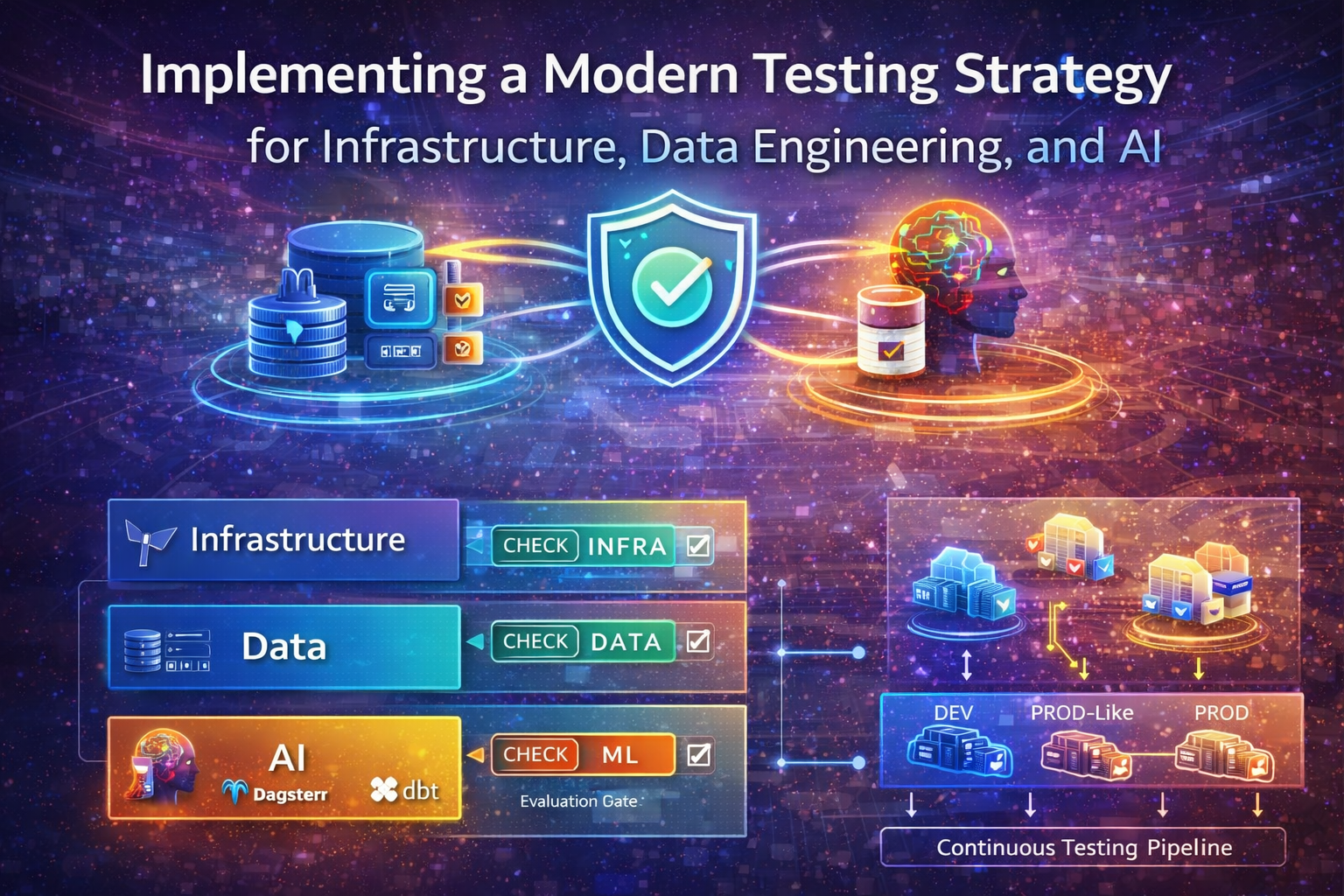
A robust testing strategy must span:
- Infrastructure (cloud, IAM, Kubernetes)
- Data pipelines (ingestion, transformation, orchestration)
- AI/ML systems (training, inference, monitoring)
This article outlines a holistic testing strategy based on a real enterprise data platform, showing how to implement testing as a first-class citizen across the entire lifecycle.
1. The Foundation: A Multi-Domain Testing Strategy
The platform defines testing across four core domains:
- Infrastructure
- Data Pipelines
- AI / ML
- Observability & Transparency
This ensures that quality is not isolated—it is system-wide and continuous.
Key principle: Testing is not a phase. It is embedded from the first commit to production deployment.
2. Environment Strategy: Where Testing Happens
A critical enabler of the strategy is the four-environment model:
- Experimentation → innovation & prototyping
- DEV → development & unit testing
- PRODLike → mandatory end-to-end validation
- PROD → live workloads
Why this matters
The PRODLike environment acts as the ultimate quality gate:
- Catches issues not visible in DEV
- Validates real-scale behavior
- Ensures production-readiness
Production deployment is only allowed after passing PRODLike tests
3. Infrastructure Testing (IaC & Platform Reliability)
Infrastructure is fully managed via Terraform, and testing follows a layered approach:
3.1 Static Analysis
- Validate syntax and structure
- Tools:
terraform validate
3.2 Module Integration Testing
- Test Terraform modules in isolation
- Tools:
- Terratest
- Kitchen-Terraform
- Google Blueprint Framework
3.3 End-to-End Infrastructure Testing
- Deploy full environments
- Validate:
- Networking
- IAM
- Resource provisioning
Infrastructure testing must be modular because full system testing is costly and slow
Key Best Practices
- Avoid shared state between tests
- Use ephemeral environments
- Test modules independently before integration
Outcome:
Infrastructure becomes predictable, reproducible, and secure by design
4. Data Engineering Testing (Pipelines & Data Quality)
Data testing is multi-layered and contract-driven.
4.1 Types of Data Tests
Stateless Checks
- Null checks
- Range validation
- Schema validation
Stateful Checks
- Anomaly detection
- Distribution tracking over time
Custom Tests
- SQL-based validations
- Reusable test templates
4.2 Data Quality Dimensions
Testing operates at two levels:
- Low-level → technical correctness
- High-level → business relevance
These are often generated from data contracts, ensuring alignment with business expectations
4.3 Data Diff Testing
- Compare datasets before vs after changes
- Detect unintended transformations
This is critical for:
- Refactoring pipelines
- Schema evolution
- Backfills
4.4 CI/CD Integration
Data pipelines are tested continuously:
- Unit tests (Python, Spark)
- dbt tests for transformations
- Dagster asset checks at runtime
Key Insight
Data testing is not only about correctness—it is about trust, contracts, and observability.
5. AI / ML Testing Strategy
AI systems require additional layers of validation beyond traditional software testing.
5.1 Three Categories of Quality Gates
Before deploying a model, three gates must pass:
1. Evaluation Gate
- Performance ≥ production baseline
- Tested on unseen data
- Bias & fairness validated
2. Operational Gate
- Latency within SLA
- Model registered and versioned
- Successful execution in PRODLike
3. Monitoring Gate
- Drift monitoring configured
- Observability enabled
- Runtime checks active
5.2 Runtime Validation
AI pipelines include:
- Feature validation before inference
- Distribution checks vs training data
- Anomaly logging
5.3 Continuous Monitoring
AI testing does not stop at deployment:
- Data drift detection
- Concept drift monitoring
- Output validation
A model can be operationally healthy but logically wrong—monitoring closes that gap.
6. Observability & Transparency as Testing
Testing extends into production visibility:
- Alerts and incident tracking
- Data quality metrics per pipeline
- AI model performance signals
- Infrastructure monitoring
Reporting Cadence
- Data quality → per pipeline run
- Tests → per deployment
- AI signals → per inference cycle
This creates a continuous feedback loop.
7. CI/CD and Quality Gates
All domains integrate into a unified CI/CD pipeline:
Core Testing Layers
- Linting & formatting
- Type checking
- Unit tests
- Data tests (dbt, Dagster)
- Infrastructure validation
- Security checks (SAST)
Deployment Principle
No promotion without passing all required tests in the target environment.
8. Key Design Principles
From the strategy, several core principles emerge:
1. Shift Left
Test early (DEV), not just before production
2. Shift Right
Monitor continuously in production
3. Environment Fidelity
PRODLike must mirror production
4. Modular Testing
Break systems into testable components
5. Contract-Driven Validation
Data and AI behavior defined by contracts
6. Observability = Testing
Monitoring is part of validation
Conclusion
A modern testing strategy for data platforms must evolve beyond traditional software testing.
It must:
- Treat infrastructure as code—and test it
- Treat data as a product—with contracts and quality guarantees
- Treat AI as a probabilistic system—with continuous validation
The result is a platform that is:
- Reliable
- Scalable
- Auditable
- Trustworthy
Next Steps
- Assess your current testing maturity across infrastructure, data pipelines, and AI workloads
- Identify critical gaps in quality gates, observability, and environment strategy
- Define a unified testing approach aligned with your platform architecture and CI/CD processes
- Implement testing across DEV and PRODLike environments as mandatory quality gates
- Launch a pilot use case to validate reliability improvements and measurable impact
Contact Datilis to design and implement your end-to-end testing strategy