

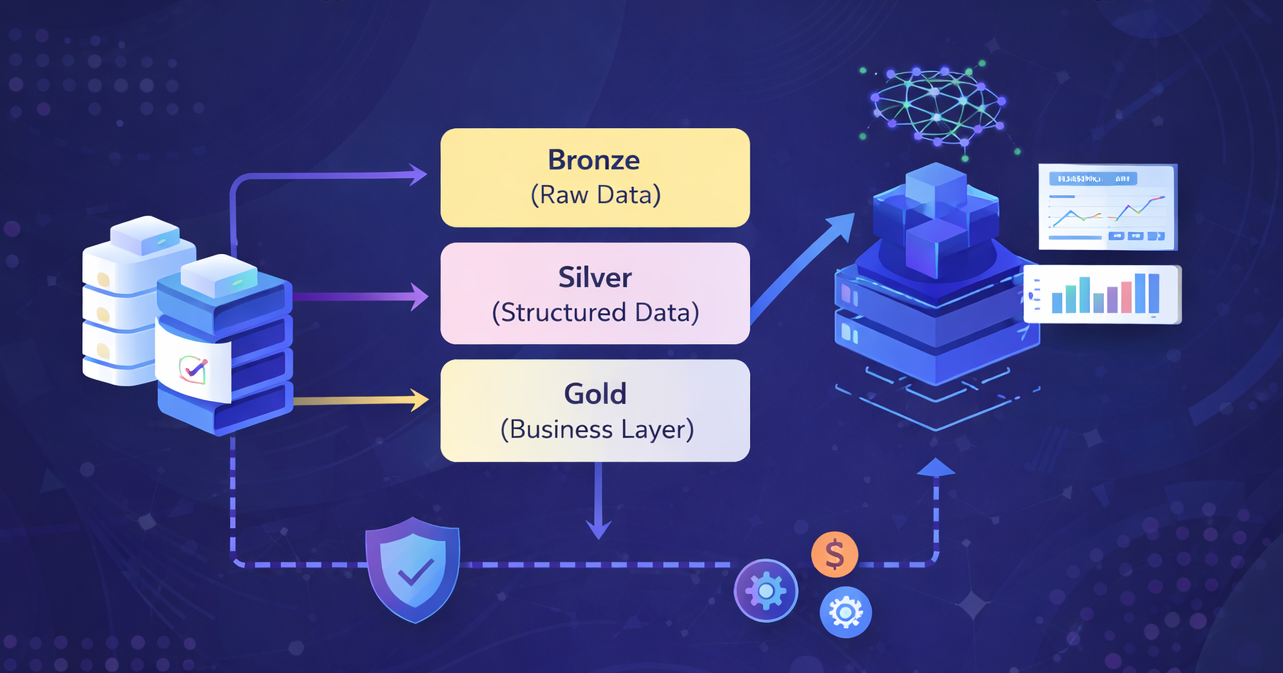
Organizations today are under increasing pressure to turn data into real business value. However, many still struggle with fragmented systems, inconsistent data, and limited scalability.
At Datilis, we design and implement modern, cloud-native data platforms that enable organizations to move from raw data to actionable insights and AI-driven decisions.
In this article, we present a reference architecture for a target data platform, covering the full lifecycle, from data ingestion to machine learning and business activation.
The Challenge: From Data to Value
Most companies face similar challenges:
- Data is scattered across multiple systems
- Pipelines are difficult to maintain and scale
- Analytics lack consistency and trust
- AI initiatives are blocked by missing foundations
A modern data platform must address all of these challenges holistically, not as isolated components.
The Datilis Target Data Platform
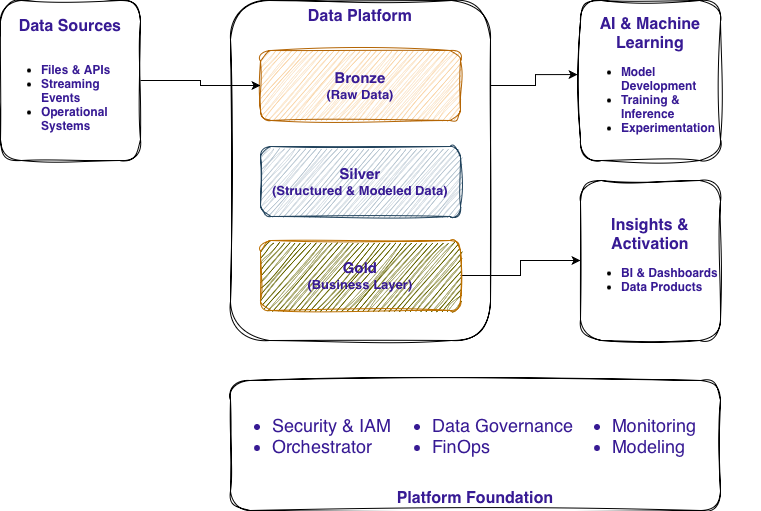
Our recommended architecture is built around four key layers:
1. Data Ingestion
2. Data Processing
3. Machine Learning
4. Insights & Activation
Each layer is designed to be scalable, governed, and production-ready.
1. Data Ingestion: Bringing Data Into the Platform
Data enters the platform through multiple sources:
- Batch ingestion (e.g. SFTP, JDBC)
- Streaming ingestion (Kafka, Confluent)
- External systems and APIs
To ensure scalability and reliability, we implement:
- Ingestion as a Service
- Standardized ingestion pipelines
- Decoupled architecture for flexibility
This allows organizations to onboard new data sources quickly without redesigning the platform.
2. Data Processing: Structured and Governed Data Layers
At the core of the platform is a layered data architecture:
Bronze Layer
- Raw, ingested data
- Stored in scalable storage (e.g. cloud storage, HDFS, S3)
- Cleaned data by applying data quality checks and historized.
Silver Layer (Data Vault / Structured Layer)
- Cleaned and transformed data
- Standardized models for reuse
Gold Layer (Business Layer)
- Business-ready datasets
- Optimized for analytics and reporting
Transformation & Processing
We use modern tools and frameworks such as:
- dbt for transformations
- Spark for scalable processing
- Modular pipelines for flexibility
This ensures:
- reproducibility
- scalability
- maintainability
3. Machine Learning: Enabling AI at Scale
Once data is structured and governed, the platform enables machine learning use cases, including:
- Predictive analytics
- Recommendation systems
- Customer intelligence
The architecture supports:
- Model development and training
- Batch and real-time inference
- Integration with the data platform
This allows organizations to move from analytics to intelligent automation.
4. Insights & Activation: Turning Data Into Decisions
The final step is making data usable for business users.
We integrate with leading BI and analytics tools such as:
- Tableau
- Looker Studio
This enables:
- self-service analytics
- executive dashboards
- operational reporting
The goal is simple:
Make data accessible, understandable, and actionable
Platform Foundation: Security, Governance, and Operations
A modern data platform is not just about pipelines—it requires strong foundations:
Security & Access Control
- Identity and access management
- Secure data handling
Orchestration
- Pipeline scheduling and dependency management (e.g. Airflow, Dagster)
Monitoring & Observability
- Pipeline health
- system performance
- data quality
Governance
- Metadata management (e.g. Collibra, DataHub)
- Data lineage and ownership
- Compliance and privacy
Why This Architecture Works
This approach provides:
- Scalability → supports growing data volumes and use cases
- Flexibility → modular and extensible design
- Governance → built-in control and compliance
- AI-readiness → foundation for advanced analytics and machine learning
How Datilis Supports This Journey
At Datilis, we don’t just design architectures—we help organizations:
- Build modern data platforms
- Enable advanced analytics and AI
- Implement governance and FinOps
- Operate platforms at scale (DataOps)
Our approach combines architecture, engineering, and operating models to ensure long-term success.
Conclusion
A modern data platform is the foundation for becoming a data-driven organization.
By combining:
- scalable ingestion
- structured data layers
- machine learning capabilities
- business-facing analytics
organizations can unlock the full value of their data.
Call to Action
Want to build or modernize your data platform?
Let’s talk.
